I'm just trying this blog thing out - to see whether it's just a passing fad for me, or if it becomes a habit...
Friday, June 17, 2011
The Onion: NCC Bans Bicycle Commuters from Ottawa Recreational Path
Tuesday, May 24, 2011
Monday, May 23, 2011
Goodbye Farm

This is my last day on the farm. I can't believe it. So many things have changed in my life, but one thing was always constant - the farm. The foundation of my upbringing, the refuge from the big bad world, the weekend retreat - no longer. My parents, who are now too old to keep up with the work, sold the farm. Now, with less than two weeks to go, they will depart as well. After thirty-five years of sun, sweat, toil, mud, cows and snow, it's over. None of us six kids wanted to take over the farm. No choice but to sell. They're moving into town.
I returned for the final time on the Labour Day weekend. No longer part of the agrarian population, I now make my home amongst the high-tech industries in Ottawa. The previous week, I had been jetting to a different U.S. city each day, espousing the wonders of our product to Corporate America. Upon my return, I had managed to squeeze a side trip (the last) to my parent's farm. One day I'm stepping out in Manhattan, - the next I'm stepping into a freshly formed cowpie in the barnyard. What a contrast - from the scions of Wall Street to the cows of the barnyard.
The farm is no ordinary farm. Situated just north of the village of Leith and close to the shore of Georgian Bay, it has all of the elements of paradise. The farm, one-hundred and fifty acres in total, is bordered on three sides by dense bush. The fourth side, which faces to the south affords an unobstructed view all the way to Owen Sound. In the distance, amongst the shimmering tin barn rooftops, I can see the farmhouse where Tom Thomson grew up. The beauty of the landscape, which he began to appreciate here, and finally expressed in a form that became our national treasure, is the very same beauty I grew up with. I know exactly what he felt and what he wanted to express. I've seen his early works, paintings of the area, and he has captured the very same mood that I feel now. To the west, above the trees of the near shore and below the far shore, I can see a blue sliver of Owen Sound Bay. Further to the north, the sliver opens into greater Georgian Bay and, with distant clouds, fuses with the sky. Here, it's the top of the world. I can see the entire world, or what really matters to me. The world needs to be no larger than what I can see.
What is the best way to say goodbye? I've often heard that lingering goodbyes are the worst. I've also heard the best goodbyes are the quick ones that have a real sense of closure. When I was a kid. I remember the goodbyes to visiting relatives from Holland. Often during the summer, aunts, uncles, grandparents, cousins, from the old country would come and stay with us on the farm. During the brief weeks, they would become part of my world - the farm, and I would grow to love them dearly. Then, in the front yard where I am standing now, the visit would abruptly come to a close. The final goodbyes were exchanged. They were always brief and packed with emotion that was most often not shown. Suitcases packed in the trunk, visitors in the back seat, and my parents in the front, the car would begin its journey down the long hilly laneway. Not wanting to finish the goodbye, I would race back into the house, up the stairs to the bathroom where the window would give me a better view of the laneway. I could see the car go down the big hill, disappear from view, briefly appear at the rise of the middle hill, disappear once more, re-appear again, and as it made its final climb, disappear into the bush. I would wave but I knew they couldn't see me. The waving and the glimpses from the better view made the good-bye less painful. It consoled me. Now, as I walk around the farm, I feel that I am doing the same. I am consoling myself, as I survey the farm, snatching final glimpses, extending my goodbye.
Not only will I have to say goodbye to the farm as a whole, but also the house and the barn. The house is an old fieldstone house, older than the country itself. It is actually several houses in one. Starting from the back, a decrepit shed complete with an out-moded outhouse, next, to an old mundane middle brick part, and finally, culminating in the front, stands proudly the beautiful solid fieldstone structure. Built by a Scottish settler who was given a grant from the Queen's Bush, and using the glacial errata cleared from the fields, this is a true Southern Ontario fieldstone house, gathered , hewed and built from the geography and its residents . The barn too, like the house, is several barns in one. Viewed from the sky, it has the shape of a gargantuan, squared 'C' punctuated by a silo. From the ground, the aged gray cedar barn boards give testament to their time bared to the elements.
My flight back to Ottawa leaves soon. I must say my final goodbye. Like the goodbyes to my relatives from Holland, it is brief, emotional and silent. Suitcase in the trunk, me in the back seat, and my parents in the front, we begin the journey down the laneway. I look out the back window to catch the last glimpse. I can see the barn and the entire farm rising up behind. The house and bathroom window disappear and re-appear as we dip between the hills. Maybe the farm is waving goodbye and I cannot see. Maybe it too feels the pain that I do. We're near the end of the laneway. We make the final ascent and enter into the bush. The farm disappears from view. The last glimpse is seared in my brain. There are tears in my eyes. Goodbye Farm.
Sunday, April 17, 2011
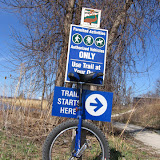
Unicycling the Tom Thomson Trail 2011 Edition
Monday, May 10, 2010
Highlights of my Tom Thomson Unicycle Adventure

Thursday, May 06, 2010
Unicycle Live! from the Tom Thomson Trail
I will be posting pictures along the route at my Facebook account.
GPS tracking powered by InstaMapper.com
Here is my route courtesy Google Maps
View Unicycle Routes in a larger map
Pictures as they become available will be posted here
![]() |
| PhotoScatter.com Uploads |
Monday, May 03, 2010
Friday May 7th is the date!
Thursday, April 08, 2010
Unicycling for a Smaller World
2. I must carry all my gear, water, and food. Any replenishment, especially water, must be found along the route and not separately carried in by someone else (especially someone driving a Hummer)
3. To make things interesting and challenging, the route must be reasonably off the beaten path. Trails from old railways, forgotten concession roads, fit the bill perfectly
4. Whatever the unicycle adventure might be, there should be a link to something that is larger than the adventure itself.
- We all yearn for a small world - we don't want empty physical space, rather we want a link to a rich textured world of relationships where everyone and everything feels close and comfortable (but not claustrophobic).
- We live in a small world - for the past few millenia we thought our world was huge, limitless (and scary). That's not the case, it's limited in resources and we only have one blue dot in space to call our home (undiscovered exoplanets notwithstanding). The earth might look big from down here, but our world is truly small.
- Your world is small when you unicycle - unlike other modes of transport where you can drift off temporarily or coast without adverse consequence, that's not the case with unicycling. You must be continually aware, engaged or fall flat on your face. To do this, you must focus, which narrows your perception to your immediate surroundings (especially bumps). This forced 'smallness" yields a completely different experience than cycling , walking or driving; Unicycling provides you with an unsurpassed richness of the route.
Tuesday, April 06, 2010
Getting Ready for the Tom Thomson Unicycle Trip
Friday, March 26, 2010
Mapping My Tom Thomson Unicycle Route
Sunday, January 24, 2010
Unicycling the Tom Thomsom Trail in May 2010
Other than riding the trail, I've not yet made any plans for fund-raising or sponsorship. I am doing this first and foremost as a personal challenge, but if anyone has any idea to make this a more fun and meaningful event I am open to suggestions. Dave Adair has agreed to be my local PR Manager and he is already dreaming up sensational headlines.As my plans develop, I will keep everyone up-to-date who is interested.
Sunday, April 05, 2009
Tuesday, January 02, 2007
Chess-in-the-Street 2007
Tuesday, June 13, 2006
Successful Chess-in-the-Street
You can see the photos of the event (in reverse chronological order) at:
http://www.flickr.com/photos/timbouma/show/
Tim
Monday, March 27, 2006
Building an Alternative Theory of Identity
To appreciate where I am coming from, or to better understand what I am trying to convey to you - I'm not interested in solving the Single-Sign-On (SSO) problem, or building another SAML or Federated Identity solution - as most vendors are doing a great job of this already. I am trying to understand, what are the necessary concepts required to build a new social institution that is built upon an alternative identity.
'A new social instituition?! An alternative theory of identity?!', you ask. 'That's pretty crazy!!'.
Well so be it! To paraphrase a tired cliche, to better understand the box you're in, figure out what it looks like on the outside and understand the table it sits on.
I came upon this thinking, when one of my public sector colleagues made the very intriguing statement several months back that 'we have an implicit identity management scheme throughout our systems of government'. In Canada, we have formalized privacy as an 'institution' by means of legislation and the creation of an Agent of Parliament, namely the Privacy Commissioner. So the question came to mind - what if we formally institutionalized identity - what would it look like? Would we have an Identity Commissioner? What principles would this institution have? And, what powers? You have to think about all this stuff, even before you start designing systems that support the institution.
As I've been thinking about this question, I've found that Kripke's writings are shedding a different light on the identity management problem and providing useful avenues of thought.
I haven't yet tackled, Kripke's original work, Naming and Necessity (I have to buy it from Amazon or check it out of University Library, once I find my alumni card). But I have found several derivative works on the web that have helped me immensely, in particular this essay by John Burgess from Princeton. Burgess does a particulary good job of describing the shortcomings of the Descriptive Theory of Reference and its band-aid, the Cluster Theory. These two theories fall down when taking into account the problems of error and ignorance. In a nutshell, if I knew George Bush, but thought he was the 41st President of the United States (his dad), or didn't know that he was the 43rd Prez, does this diminish the reference that I have of him? The fundamental shortcoming of the descriptive theory, is that no matter how well or completely I describe someone, these descriptions still falls short of the absolute reference I desire.
Kripke offers an alternative view - one based upon the historical chain - the causal event chain, that begins with 1) baptism - an act of ostension (picking out) and bestowing a name (the baptiser being the first user of this name) and, 2) transmission, the subsequent use of this name by later users to pick out the same thing that was baptized. This posting is getting long - I'll elaborate historical chain concept in a subsequent posting
So, in building my alternative theory (enough to develop a new social institution, that is) this is the concept inventory so far:
- Social Actions, and Social Relations, courtesy Max Weber,
- Absolute Reference and Identity, courtesy my own musings
- Historical Chain, consisting of baptism and transmission, courtesy Kripke.
And, to act out this theory, we have our IDM Dramatis Personae, consisting of Alice, Bob, their friends, enemies, etc.
'til next time
Any comments on this blog or welcome or mailto: - tim.bouma @ sympatico.ca (only human-generated mail is welcome)
Tim Bouma
Friday, March 24, 2006
Tim Horton's IPO - best thing since the Netscape IPO
In case you missed it - According the Globe and Mail today, - this is truly the most exiting IPO, since the 1995 Netscape IPO.
Investor appetite for Canadian coffee and doughnut icon Tim Hortons Inc. surpassed already lofty expectations Friday, with the shares jumping about 30 per cent on its first day of trading
(see full article Tim Hortons IPO )
In truly Canadian fashion, many of the reader's comments are about how bad the coffee is, and how they won't be successful in the US market. To be successful in the US, I proposed that we change the name to Stan Mikita's Donuts.
Thursday, March 23, 2006
Identity Management - A Play Overview and Dramatis Personae.
So here we go:
Play Overview:
The play begins with Alice wanting to send a message to Bob, her true love. After going through the whole cryptographic rigamorole, and sending intimate messages to one another, Alice begins to doubt Bob's true identity. Thus, she begins a quest to find the truth by asking their mutual friends, Carol and Dave for proof. As with any good play, plot complications and evil characters arise; Eve, Mallory, and Oscar (Alice's unrequited lover) thwart her at every turn. The chain of events involve exceptional malice and spite and culminate in an appearance before the courts, where Justin, the judge resolves the dispute, uncovers the truth, and puts the bad guys in jail. All ends swimmingly, as Justin is suddenly called to preside over an impromptu wedding ceremony. Who gets married to whom? You'll have to wait for the play to be written before you find out!
IDM Dramatis Personae:
The cast, in order of the alphabet:
Alice and Bob. The main characters. The first known archetypal individuals used to explain cryptographic protocols. These characters were invented by Ron Rivest but he never did explain the relationship between the two of them. This play hopes to explore that aspect.
Carol and Dave, third and fourth participants in communications between Alice and Bob. All four are close friends, but we're never sure how close or what the word "friend" really means for them.
Eve, an eavesdropper, is a passive attacker. While she can listen in on messages between Alice and Bob, she cannot modify them.
Isaac, an Internet Service Provider (ISP). As a result of the Patriot Act, Isaac and Plod (the police officer) have become very good friends.
Ivan, an issuer (as in financial cryptography). No connections with the Russian counterfeiting ring - shame on you for thinking that.
Justin, from the justice system. Clean as a whistle - until he whets his whistle.
Mallory, a malicious attacker; unlike Eve, Mallory can modify messages, substitute her own messages, replay old messages, and so on. The problem of securing a system against Mallory is much greater than against Eve because Mallory has violent tendencies. To further add to the intrigue, Mallory has two evil identical twins of the opposite sex named Marvin and Mallet. I guess that makes them identical triplets - andthe opposite sex thing really throws a good wrench into the main plot and provides great basis for an identity-crisis sub-plot.
Matilda, a merchant (as in ecommerce or financial cryptography). Matilda sells something to do with images, but you'd better ask Steve what exactly this is.
Oscar, an opponent, is usually taken as equivalent to Mallory.
Pat or Peggy,, a prover, and Victor, a verifier, who often must interact in some way to show that the intended transaction has actually taken place.
Plod, a law enforcement officer (P for police, also "Officer Plod" inspired from the children's TV show Noddy). Plod has a secret MD5 hash problem.
Steve, an agoraphobic extrovert, obsesses over Steganography. Steve used to work for a unnamed Port Authority but the fresh air in the vast expanse of the dock container-yards was too much. Due to what might be considered a career-limiting-move (if they find out), Steve quit and found better, more profitable things to do with his time.
Trudy, an intruder: another alternative to Mallory. Could the triplets actually be quadruplets? To sort out this evil quadrangle will require some pretty sophisticated biometric technologies.
Trent, a trusted arbitrator, is some kind of neutral third party, whose exact role varies with the character and topic under discussion. Trust, in Trent's view, is merely a stepping stone to bigger and better things. Trent has aspirations of running for President.
Walter, a warden, may be needed to guard Alice and Bob in some respect, depending on the gravity or absurdity of the situation.
Zoe, the last party to be involved in a cryptographic protocol. Zoe's always the last to the party, but she more than makes up for it by being the last to leave!!!
Absolute Reference and Identity
Like a craving for chocolate -we desire things that comfort and satisfy us. Absolute references are something we crave - because we want things in our life that don't change. We want things that are constant - they're the same every time we encounter them. For some, it's mom's home cooking, or the bedroom that hasn't changed since the teenaged years, despite moving out. On a grander scale, an absolute reference might be someone's belief in, unchanging god, or a set of humanistic or nationalist principles that they are willing to die for.
With more earthly matters, we need absolute references as a basis to our relationships in family and society. My mother will always be my mother even if she decides to change her name. My first point is that we try to relate to people with the best absolute reference we can - in the case of my mother - it's that mother-child bond, which trumps any name. To this day, I don't call my mother by her real name - still mom. For others next best absolute reference is their given name. People to whom we have lesser relationships, we use their name, and that's how we build relationships and function in a larger society.
My second point is that identity is a function that serves to provide this absoulute reference. My observation is that the prevailing schools of identity management a) don't recognize the distinction between absolute reference and identity, and, b) follow the Descriptive School of Reference. The implication of this school of thought on identity is that if you gather enough information about an individual, the more sure it's him/her.
In keeping with Kripke, I believe that a) absolute reference is distinct from identity, and b) we should follow the Casual Theory of Reference, where our best references are actually arise from an unbroken chain of historical events (cause and effect). This is the avenue we must explore if we are to understand the nature of identity. I'm not advocating either/or. In both schools a different light is shed on the problem.
My personal prize in these musings is a simple yet profound insight that can shift our thinking as we craft policy, build system, and invent technologies.
'til then
Tim Bouma
Monday, March 13, 2006
Ottawa Chess-in-the-Street
Hi everyone,
The details have been finalized and I am pleased to announce "Chess in the Street" to be held as part of Ottawa's biggest street festival WESTFEST, on Saturday and Sunday, June 10th and 11th, 2006.
The official announcement on the WESTFEST site :
"Chess-in-the-Street is an outdoor chess event that takes the game of chess from the parlour to the street. Chess-in-the-Street will have numerous activities appealing to everyone: from kids to adults and from those who have never played before to the seasoned tournament player. With each game you play, your name will be entered in a draw for prizes. Chess-in-the-Street will also have GIANTCHESS!, a giant-sized chess board on the street. There will be a Simultaneous Chess Competition in the afternoon each day, featuring a ChessMaster who will battle 15 simultaneous chess opponents. June 10th, 11th, 2006, 10 am through 4 pm Richmond Road & Roosevelt Avenue".
Some items of note:
First of all, this is an OUTREACH EVENT, not a tournament. The theory goes, that there are tons of people who are aware of chess, but not aware of what chess can offer to them (like the author, two years ago) The success of this event depends only upon the people discovering the wonders of chess in a novel and festive setting.
Second, the author would like to thank the gracious support of the producer of WESTFEST, who managed to squeeze us into this very popular event (expected attendance of 30,000-50,000.) To appeal to kids, a big part of WESTFEST, we have situated Chess-in-the-Street within the WESTFESTKIDSZONE to encourage kids, their parents and any brave adults to play with one another.
Third, the author would like to thank the Chess-and-Math organization (in particular, Larry Bevand and David Gordon) for their enthusiastic support and lending us the GIANTCHESS set for the occasion.
Finally, we're still looking for volunteers and sponsors to help - mostly to hang out and encourage people to play - we'll be having 8-10 boards open during the course of the day, and if there are sufficient and willing chess souls out there, we're planning to conduct simuls to wrap up each day. If you wish to help out, please let me know at: e-mail:tim.bouma@sympatico.ca
All in all, Chess-in-the-Street should be quite a spectacle. If it works this year, we may consider growing it into an annual festival event, including rated tournaments etc. But for now, the focus this year is simply to bring "Chess-in-the-Street".
Thanks to all, who have made this a happening, and thanks in advance to those willing to pitch in.
Thursday, March 09, 2006
Does Hamlet have an Identity?
This question was inspired by several things.
First , due to my ponderings of identity as a reference, courtesy the philosopher, Saul Kripke, who came up with the Causal Theory of Reference and Theory of Proper Names (the Bart Simpson version of this can be found here )
Second, upon reading an article by David Weinberger, entitled The Year of the Unique ID. where he discusses how we should uniquely identify Shakespeare's creation of Hamlet, as a work, expression, manifestation, or item.
I realized through my hazy Kripke lens, I should ask the silly but profound question "Does Hamlet have an identity?". Some might say, this is a ridiculous question, because Hamlet is a fictional character. Practically speaking, yes, but by pursuing this question, we can learn more about the true function of identity - a question that gets easily swept under the rug.
I'm on work time right now - so I'll keep the following short: I'll pose some related questions.
Does Hamlet need an identity? - Hamlet himself, does not - but we need to ascribe him one - if we are to have a conversation about him. We need to have a common reference. Shakespearian scholars need to give Hamlet an identity, if they are to analyze his motives, feelings, etc. If we can't arrive at a common or definitive reference (it's just some guy in a play) - then we can't progress very far on Hamlet.
What exactly is Hamlet's identity? If you take the identity management vendor approach - it's his name, date-of-birth, SSN, plus some biometric. Heck, I'll have to re-read the play to see whether Hamlet has blue eyes, but I don't think I'll be able to scan his irises?
What does identity really serve? My hunch is that identity serves our need as human beings to have absolute references (as best we can) to one another. My friends and family want to know me as 'me", regardless of my name, date-of-birth or where I live. These things only serve to help my friends and family relate to me. They might be ascribed to me as my "identity", but I'm starting to realized these things are not actually my identity. They're only things that help other people relate and interact with me.
I believe if we figure out how we relate to Hamlet as a fictional character, we can apply this to the real world, and better undertand how others (and their supporting systems) should best relate to me as a real character.
That's it for now!
Tim